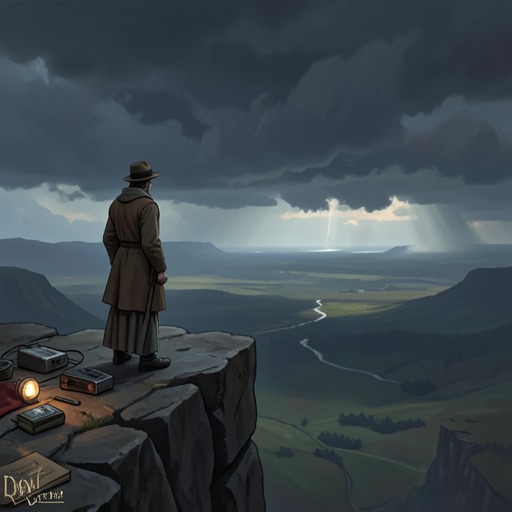
Sneffels’ extinct state
A Journey to the Centre of the EarthSneffels’ extinct state makes the descent into the volcano appear possible, but never wholly safe. The mountain has been silent since 1219; Professor Hardwigg treats its long dormancy and the ordinary behavior of its vapor vents as evidence against an imminent eruption, while Henry sees that silence cannot promise what the volcano will do next. The distinction between an extinct volcano and a harmless one shadows the expedition, as geological theory is tested against what the travelers observe underground.
Definition and the Expedition’s Premise
When Professor Hardwigg identifies Sneffels on the horizon, he calls it one of the most curious volcanoes in existence and notes that its crater has rarely been visited. Asked whether it is extinct, he answers that it has been so for five hundred years. Elsewhere, he gives the longer historical measure: about three hundred volcanoes are found across the globe, most of them extinct, and Sneffels has had no eruption since 1219. In his emphatic formulation, the mountain has ceased to be a volcano at all.
That description helps turn an alarming geological feature into an apparent route. The expedition intends not merely to climb Sneffels but to enter its crater and, if a passage can be found, descend into the earth. The mountain’s dormant condition is therefore more than background: it is the practical assurance on which the plan rests. If an eruption begins while the travelers are inside, the same crater that offers an entrance could become a trap.
Doubt at Stapi
Henry is not reassured by the date of the last eruption. He reasons that a volcano’s long sleep does not prove that it will never wake, and worries that an eruption might begin while the party is lost in the volcano’s underground galleries. His fear is not simply that the descent is difficult. It is that the expedition may place its members beyond escape just as the mountain becomes active again.
Professor Hardwigg takes the objection seriously enough to investigate before setting out. At Stapi, he says he has closely examined the inhabitants and carefully studied the soil. He concedes that Sneffels, though silent for six hundred years by his reckoning, may speak again, but insists that there will be no eruption at present. His confidence answers Henry’s immediate concern, not the more fundamental uncertainty Henry has raised: a prediction about present conditions is not a guarantee of permanent safety.
Reading the Volcanic Signs
Hardwigg supports his judgment by pointing to vapor issuing through fissures in the ground. He explains that, as an eruption approaches, these vents become more active, then disappear during the eruption itself, when elastic gases turn inward toward the crater rather than escaping through the fissures. If the vapor remains at its normal level, does not grow more energetic, and is not accompanied by the relevant atmospheric change, he concludes that there is no immediate danger.
The exchange presents the mountain’s status as something inferred from observable signs, not simply accepted from its reputation. Hardwigg’s confidence depends on reading the vents and the weather; Henry, listening to him, is stupefied but remains doubtful. The professor closes the discussion by invoking science as an authority to obey. Yet the scene preserves the gap between interpreting conditions correctly and knowing what the volcano may do later. Dormancy is measured through signs that support a forecast, while the expedition still enters a place whose future activity cannot be ruled out once and for all.
Silence, Measurement, and Contradictory Evidence
That gap belongs to a wider pattern in the journey: observations and scientific expectations repeatedly meet, and do not always agree. In the underground passages, the travelers encounter geological formations that prompt claims about the sequence of strata and the development of ancient life. Henry identifies Silurian rock as a transition in their course; later, fossils in the marbles appear to record increasingly developed forms of animal life. Such findings turn geological time into a physical landscape, but they also complicate confidence about where the travelers are and what the evidence signifies.
The instrument readings make the same tension explicit. When Professor Hardwigg asks for the thermometer’s temperature, Henry reports twenty-seven and six-tenths degrees. Hardwigg contrasts that measurement with the expected increase in heat and declares the usual proportional rule wrong, affirming his confidence in Humphry Davy’s account. The scene does not erase the need for interpretation: the thermometer gives a reading, and the professor uses it to revise a theory. In the account of Sneffels, too, evidence of present conditions can guide action without abolishing uncertainty about what lies ahead.
The expedition’s encounters with ancient life extend this testing of expectation. A fish initially taken by Henry for a sturgeon has a flat head, rounded body, bony scales, toothless mouth, and unusually developed pectoral fins; Professor Hardwigg’s examination identifies it instead as belonging to a family known only from Devonian fossils. Elsewhere, the travelers’ progress through geological formations and their discoveries of prehistoric remains bring deep time into direct contact with the expedition’s present. These episodes do not establish that Sneffels is about to erupt, but they make the underground world resistant to simple assurances: observation keeps producing particulars that existing expectations must accommodate.
Narrative Significance
Sneffels’ long silence carries two meanings at once. It supplies Professor Hardwigg with a reason to proceed, and it gives Henry a reason to fear that the expedition has mistaken an interval without eruption for lasting security. The difference matters because the descent makes the cost of error unusually high: the travelers plan to enter the crater and follow passages into the earth, where an eruption could cut off their return.
The volcano’s dormant state thus anchors the novel’s recurring contrast between scientific authority and the limits of prediction. Hardwigg’s reading of vapor and atmospheric conditions is presented as a reasoned assessment, not as a guarantee that nature has surrendered its power. The mountain remains quiet long enough for the expedition to begin, but that quiet cannot settle the question Henry asks: whether a volcano that has slept for centuries may still wake.